
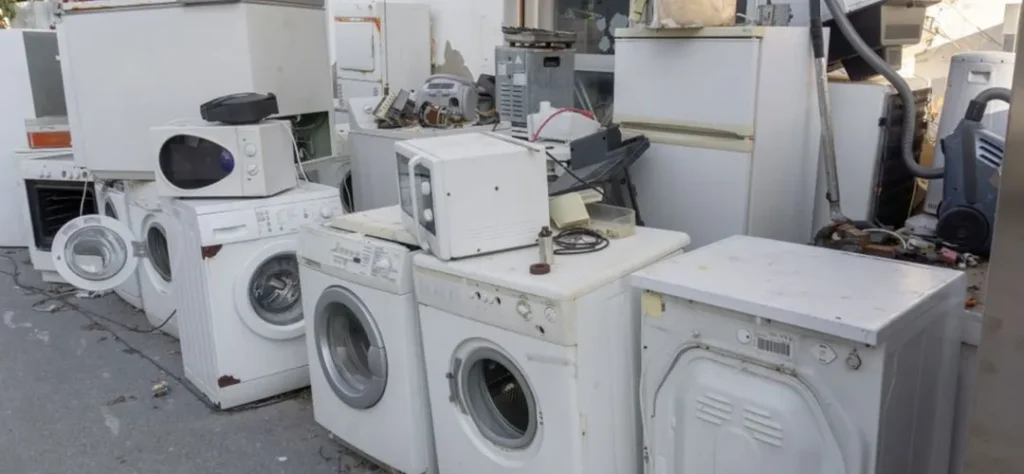
Appliance removal usually starts with a moment like this: it’s 9 p.m., your washer stops mid-cycle, and a puddle spreads across the laundry room floor. It’s the third repair this year, and you’re wondering whether to fix it again or finally let it go.
That decision is hard because old appliances rarely die all at once. They fade slowly, and it’s easy to keep patching them up. This article covers five clear signs that it’s time to get rid of an old appliance, how to weigh repair against replacement, and what to do with the old unit once you decide.
Why Knowing When to Let Go Matters
Holding onto a failing appliance costs more than it seems. You pay for repeated service calls and higher utility bills, and you take on safety risks. Meanwhile the dead weight takes up space in your kitchen, garage, or basement.
Most household appliances have a typical lifespan, though it varies by brand, model, and how hard you use them. As a rough guide:
- Refrigerators often last around 10 to 20 years.
- Washers and dryers commonly last about 10 to 13 years.
- Dishwashers tend to run closer to 9 to 12 years.
- Ranges and ovens can last 13 years or more.
Age alone doesn’t mean an appliance has to go. A 14-year-old fridge that runs quietly and keeps food cold is doing its job. The signs below matter more than the number on the calendar.
Sign 1: The Repair Bill Is Close to the Price of a New One
This is the classic test, and it works. Many repair technicians use a simple rule of thumb: if the repair costs about half the price of a comparable new appliance, replacement is usually the smarter move.
Here’s a practical example. Say your dishwasher needs a new control board and the quote is $300. A decent new dishwasher costs about $600. You’d be spending half the price of a new unit to keep a machine that’s already near the end of its life. The next part to fail is probably not far behind.
Consider the appliance’s age too. A $200 repair on a five-year-old washer makes sense. The same repair on a twelve-year-old washer is mostly a gamble.
Sign 2: It Keeps Breaking Down
One repair is normal. Two in a year is a warning. Three means the appliance has told you what it wants.
Repeated breakdowns often mean the problem isn’t one bad part but general wear across the whole machine. Motors, seals, sensors, and wiring all age together. Fix one and another gives out a few months later.
You may also notice the appliance gets harder to fix over time. Manufacturers stop making parts for older models, so technicians have to hunt for used or aftermarket replacements. That drives up both the price and the wait.
Pay attention to the small warning signs too:
- A refrigerator that cycles on and off constantly
- A dryer that needs two or three cycles to dry one load
- An oven that heats unevenly or won’t hold its temperature
- A washer that shakes violently or leaves clothes soaking wet
Any one of these is annoying. Several together mean the appliance is worn out.
Sign 3: Your Energy Bills Keep Creeping Up
Older appliances are often less efficient than modern ones, and they get worse as parts wear down. A refrigerator is a good example because it runs around the clock. When its compressor (the component that circulates refrigerant to keep things cold) struggles, the fridge runs longer to hold the same temperature. Every extra hour shows up on your electric bill.
Check for these clues:
- The appliance feels hot on the back or sides, or runs almost nonstop
- Your utility bill rose without a change in how you live
- The unit is loud, humming or rattling more than it used to
- Frost builds up in a freezer that used to stay clear
Newer models, especially ones with an Energy Star label, are designed to use less power for the same job. If you replace a very old refrigerator, the savings can add up over the years. Your actual savings depend on the model, your local rates, and how you use it, so compare the yellow EnergyGuide label on any new unit before buying.
Sign 4: It’s Become a Safety Hazard
This is the one sign you should never wait on. Some problems can’t be repaired safely, or aren’t worth the risk while you decide.
Stop using the appliance and get help if you notice:
- A gas smell near a stove, oven, or dryer. Natural gas has an added odor, often described as rotten eggs, so leaks are easy to notice. Leave the area and call your gas provider or emergency services. Don’t flip switches.
- Sparks, scorch marks, or a burning smell. These point to electrical trouble inside the machine or at the outlet.
- Frayed or damaged power cords. A cord that’s cracked or hot to the touch is a fire risk.
- Water leaking around electrical parts. Water and electricity don’t mix, and leaks often mean seals or hoses have failed.
- A door that won’t seal or latch. On a refrigerator this spoils food. On an oven it releases heat, and on a washer it floods your floor.
For serious problems, appliance removal is often the right call rather than a repair. Once the unit is unplugged and safe, get it out of your home so nobody is tempted to use it.
Sign 5: It No Longer Does Its Job Well
Sometimes an appliance works, technically, but not well. Your fridge keeps food at a temperature that’s borderline safe. Your dishwasher leaves a film on the glasses. Your oven takes 25 minutes longer than the recipe says.
Living with a poorly performing appliance wears you down. You compensate without noticing, running things twice, watching temperatures, and washing dishes by hand first. If you’ve been working around a machine for months, that’s a sign in itself.
Your needs also change. A family that grew from two people to five may have outgrown a small washer. A remodeled kitchen may not fit the old range. An appliance that no longer suits your life is a fair reason to replace it, even if it still turns on.
Repair or Replace? A Quick Way to Decide
Not every problem means the appliance has to go. Here’s a simple way to think it through.
Repair it when:
- The appliance is less than about two-thirds through its typical lifespan
- The problem is one clear, inexpensive part
- It has been reliable until now
Replace it when:
- The repair costs roughly half the price of a new unit
- It has broken down repeatedly
- It’s a safety risk or wastes a lot of energy
- Parts are hard to find
If you’re stuck, ask a repair technician one direct question: “If this were your appliance, would you fix it?” A good technician will give you an honest answer.
What Happens After You Decide: Your Appliance Removal Options
Once you’ve picked a replacement, you still have a big, heavy machine to deal with. Old refrigerators and washers can weigh well over 100 pounds and are awkward to carry through doorways and down stairs. Here are your main options.
Ask the Retailer
Many stores offer haul-away when they deliver a new appliance. This can be convenient, though it may come with a fee, and the service may be limited to the specific type of unit you’re replacing.
Check With Your City or Waste Provider
Some areas offer bulk pickup or drop-off programs, but rules differ widely. Appliances with refrigerants often require special handling, so confirm before you set anything at the curb.
Haul it Yourself
If you have a truck, a dolly, and a helper, this can work. Be realistic about the weight, the stairs, and where you’ll take it. Scrap yards and recycling centers may have rules or fees of their own.
Hire a Professional Junk Removal Company
A crew arrives, carries the appliance out, and takes it away, so you skip the lifting and the drive to a drop-off site. It’s often the simplest option when you’re removing a large or hard-to-reach unit, or several items at once.
Common Mistakes to Avoid
A few missteps can turn a simple job into a headache:
- Leaving an old fridge or freezer outside with the door attached. Doors on unused units can be a hazard for children. Many people remove or secure the door, but check your local rules first.
- Dumping it somewhere it doesn’t belong. Illegal dumping can bring fines and harms the environment.
- Trying to move it alone. Appliances are heavy, and back injuries and damaged floors are common.
- Forgetting to disconnect it. Unplug electrics, shut off water lines, and have gas appliances disconnected by a qualified person.
- Skipping the measurements. Measure doorways, hallways, and stairwells before you move the old unit out or the new one in.
How to Prepare for Pickup
A little prep makes the process quick:
- Empty the appliance completely, including the fridge and freezer.
- Let a refrigerator or freezer defrost a day ahead so it doesn’t leak.
- Unplug it and disconnect hoses or lines.
- Clear a path from the appliance to the door.
- Take a photo of the model and serial number in case you need it later for warranty or recycling paperwork.
Ready to Clear Out That Old Appliance?
If your appliance keeps breaking, drives up your bills, or worries you every time it runs, you already know the answer. The next step is getting it out of your home safely, without wrecking your back or your weekend. Reach out to EJ Haul LLC. We handle appliance removal for refrigerators, washers, dryers, stoves, and more, so you can focus on the replacement rather than the heavy lifting. Call 314-465-9867 or visit https://ejhaul86.com/appliance-removal/ to learn more about how we can help.
Frequently Asked Questions
How old is too old for an appliance?
It depends on the type. Most major appliances start showing problems between 10 and 15 years.
Can I put an old appliance on the curb for trash pickup?
Sometimes, but rules vary. Many trash services won’t take large appliances with regular pickup, and units with refrigerants often need special handling.
Is it worth fixing an old refrigerator?
Usually only if the repair is minor and the fridge is otherwise healthy. If the fix costs about half the price of a new one, replacement generally makes more sense.
What should I do with a working appliance I no longer need?
If it still works well, consider donating or selling it. If it’s broken or unsafe, removal and recycling are the better choice.
Do appliance removal services recycle what they pick up?
Many do, but practices differ by company. Ask directly how they handle recycling and refrigerant disposal so you know where your old appliance ends up.